
Kitchen functionality is not something that happens by default. The kitchens that feel natural to move through, cook in, and gather around were built that way on purpose. Intentional kitchen design is the discipline of planning every element of a kitchen around the real routines of the people who use it, rather than around a floor plan, a trend, or a budget alone. If your kitchen constantly feels like a bottleneck, that is not a storage problem. It is a design problem.
Our Project Developers and Craftsmen have been transforming homes and elevating living spaces since 2002, with more than 8,000 jobs completed across Louisville, KY and Southern Indiana. We have seen what poor kitchen design costs homeowners every single day, and we have seen what a well-designed kitchen does for a household. This guide walks you through everything you need to know to get your kitchen right the first time.
What Is Intentional Kitchen Design?
IIntentional kitchen design means making deliberate, informed decisions about every aspect of a kitchen, from layout to storage to lighting, based on the specific behaviors and routines of the household using it. It is the opposite of default design, where cabinets are placed wherever there is wall space and appliances land wherever the plumbing or electric already runs.
Intentional design starts with questions, not measurements. How many people typically cook at the same time? Which direction does traffic flow through the kitchen? What tasks create the most friction right now? Where do family members naturally congregate, and does the kitchen layout fight that or support it? What do you like and dislike about your current kitchen? Are you interested in opening up the kitchen to another space?
The answers shape decisions about zone placement, island sizing, aisle width, storage configuration, and lighting. The result is a kitchen that reduces unnecessary steps, eliminates daily friction, and genuinely fits the life happening inside it.


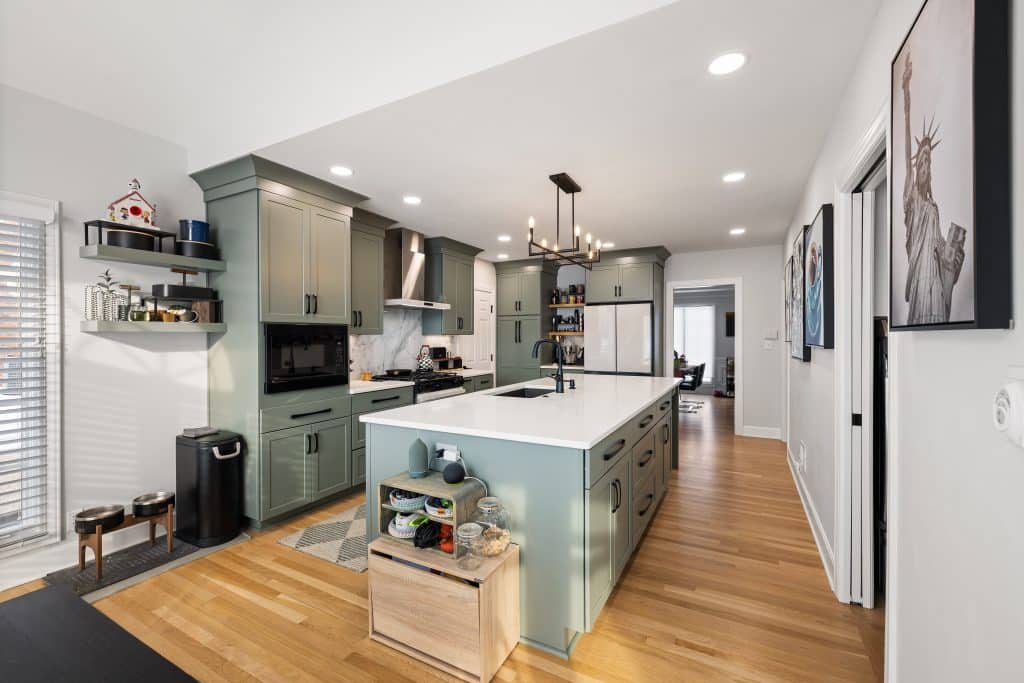
Why Kitchen Functionality Matters More Than Aesthetics
A beautiful kitchen that is hard to work in is a failed kitchen. Quartz countertops and custom cabinet hardware are easy to photograph. The daily experience of cooking in a space that does not flow well is much harder to capture, and much harder to live with.
Functionality and aesthetics are not opposites. A well-designed kitchen is almost always a beautiful one, because thoughtful proportions, clear sight lines, logical storage, and good lighting are inherently pleasing to look at and to use. But when the two conflict, function must win.
This matters financially as well. Buyers evaluating a home can sense whether a kitchen works. A kitchen that flows well, has ample counter space in the right places, and offers intuitive storage commands attention and offers lasting value in ways that purely cosmetic upgrades cannot replicate.
The Work Triangle vs. the Zone-Based Approach
The kitchen work triangle has been the foundational planning concept in kitchen design since the 1940s. It connects the three primary work points, the sink, the refrigerator, and the stove, and holds that the combined distance of all three legs should fall between 12 and 26 feet, with each individual leg between 4 and 9 feet. No major traffic path should cut through the triangle.
The work triangle is still a valid starting point for compact, single-cook kitchens. It is measurable, enforceable, and efficient within its scope. But it was designed for a different era of home life.
Modern kitchens serve multiple people simultaneously. They incorporate secondary stations like beverage bars, baking zones, and coffee setups. They open into living and dining areas, creating social flows that the triangle cannot account for. In these kitchens, the work triangle is not wrong but it is incomplete.
The zone-based approach breaks the kitchen into dedicated functional areas, each with its own tools, surfaces, and storage. Multiple people can work in different zones without interfering with each other.Secondary uses get real, dedicated space rather than competing with primary cooking tasks for the same counter. According to the National Kitchen and Bath Association, zone-based planning is now the industry standard for kitchens designed to accommodate diverse needs of different members of the household and open-plan living.
The most functional modern kitchens use a hybrid model: a tight, validated core triangle governing the primary cooking sequence, with purpose-built zones layered strategically around it.
The 5 Core Kitchen Work Zones
A zone-based kitchen is organized around five primary activity areas. Each zone should be self-contained, with the tools and storage for that task located within it rather than distributed randomly around the room.
Zone 1: The Prep Zone
The prep zone is where ingredients are washed, cut, measured, and assembled before cooking begins. It sits best near the refrigerator and pantry for quick ingredient access, and adjacent to the sink for rinsing and cleanup. Every primary cook in the household should have at least 18 to 24 inches of clear, dedicated prep counter space.
Storage in this zone should keep cutting boards, mixing bowls, knives, measuring tools, and regularly used small appliances within arm’s reach. Deep drawers outperform lower cabinets with fixed shelves here, because everything is immediately visible without bending or reaching to the back of a shelf.
Zone 2: The Cooking Zone
The cooking zone is built around the range or cooktop and oven. It requires a minimum of 12 to 15 inches of landing space on either side of the cooking surface for safely setting down hot pans, lids, and serving dishes. Overhead ventilation is not optional. Inadequate ventilation creates grease buildup on cabinetry and ceiling surfaces, degrades indoor air quality, and causes long-term damage that is expensive to reverse.
Deep pull-out drawers immediately below or adjacent to the range are the most functional storage solution for this zone. They eliminate the need to stack and dig through cookware in base cabinets with fixed shelves.
Zone 3: The Cleaning Zone
The cleaning zone centers on the sink and dishwasher. The dishwasher must be placed on the same side of the sink as the primary dish and glass storage, so the path from clean dishes to cabinet is as direct as possible. A staging counter of at least 24 inches adjacent to the dishwasher makes unloading dramatically more efficient.
Sink selection matters here. A bowl depth of 8 to 10 inches handles large stockpots and sheet pans without splashing. An undermount sink makes counter wiping seamless. Pullout trash and recycling collection bins on the opposite side of the sink provide for easy and convenient clean-up.
Zone 4: The Storage Zone
The storage zone manages dry goods, canned items, pantry staples, and consumables. Its ideal position is near the kitchen entrance, allowing groceries to be unloaded directly without routing through the active cooking area. A walk-in pantry is the highest-performance option, but a well-configured tall pantry column with pull-out shelving delivers comparable accessibility in a fraction of the footprint.
Vertical space is consistently underused in this zone. Ceiling-height cabinetry paired with an easy access step stool, or pull-out shelving that spans the full cabinet depth, can double effective storage capacity without expanding the kitchen’s footprint by a single square foot.
Zone 5: The Social Zone
The social zone is where the kitchen meets the rest of the household. It accommodates guests, family members doing homework or catching up after work, and anyone else present in the kitchen who is not actively cooking. Islands with barstool seating, and dedicated beverage or coffee stations all serve this zone without routing guests through the active work path.
Designing clear separation between the social zone and the work path is critical. An island with seating and the perimeter cabinets allows someone to move behind a seated guest without creating a bottleneck in the kitchen.
Kitchen Layout Options and When to Use Each
The layout of a kitchen is the physical foundation on which all zone planning depends. Each configuration carries distinct strengths and limitations.
- L-Shape: One of the most adaptable layouts, suited to a wide range of room sizes. Works exceptionally well with an added island for extra prep surface and social space. The interior corner requires a carousel, pull-out swing tray, or dedicated corner solution to prevent dead storage.
- U-Shape: Maximizes perimeter counter space and creates an enclosed, efficient work area. Best for households where dedicated cooking and ample prep space are priorities.
- Galley: Two parallel runs of cabinetry create an efficient cooking corridor. Well-suited to narrow rooms or households with one primary cook. Under-cabinet task lighting and continuous counter runs are essential to prevent the layout from feeling closed in.
- One-Wall: A freestanding island opposite the wall transforms this layout into a functional two-run kitchen and adds the zone separation that a single wall cannot provide on its own.
- Island-Centric: The island remains the hub for prep, dining, homework, and social interaction. Requires careful planning: a minimum 42-inch work aisle on all functional sides, 48 inches for multi-cook use, and built-in electrical outlets in the island for appliance use.
Clearances, Aisle Widths, and Safety Rules You Cannot Skip
Clearances are not preferences. They are the difference between a kitchen that is safe and efficient and one that is not. These numbers should be treated as minimums, not targets.
- Single-cook work aisle: 42 inches minimum
- Multi-cook work aisle: 48 inches minimum
- Clearance in front of open oven door: 48 inches
- Clearance in front of open dishwasher door: 48 inches
- Walkable aisle on island seating sides: 54 inches minimum
- Refrigerator landing space: At least 15 inches of counter on the handle side
- Cooking surface landing space: 12 to 15 inches on each side
- Prep counter per cook: 18 to 24 inches minimum
Violating any of these clearances creates daily friction and genuine safety hazards. Two people opening the oven and dishwasher at the same time in a kitchen without adequate clearance is not just inconvenient, it is dangerous.
Storage That Supports the Way You Actually Cook
In most kitchens that feel overcrowded or disorganized, the root problem is not a shortage of cabinet space. It is a mismatch between how storage is configured and how it is actually used. Standard base cabinets with fixed shelves are the least efficient storage solution in a modern kitchen, and they remain the most common one.
When organizing your kitchen, store everyday essentials where you can grab them without searching, stretching, or walking across the room. Keeping items visible, accessible, and close to where they’re used makes cooking and cleanup much easier.
The storage upgrades that deliver the most impact in real kitchens include:
- Deep pull-out drawers replacing base cabinet shelving in the prep and cooking zones, giving immediate visibility and access to everything stored inside
- Pull-out pantry trays or pantry column that reveal the full contents of dry storage with a single motion
- Vertical tray dividers in upper or tall cabinets for baking sheets, cutting boards, and serving platters
- Blind-corner carousel or pull-out solutions to recover the dead space inside L-shape corner cabinets
- Drawer inserts and organizers in utensil and spice drawers that keep the prep zone clear and functional
- Ceiling-height upper cabinetry paired with a step stool or ladder to capture vertical space that standard 36-inch upper cabinets leave unused
Kitchen Lighting Done Right
A single row of recessed cans or one overhead fixture is not a kitchen lighting plan. It is the absence of one. A functional kitchen requires three distinct layers of light, each serving a different purpose and independently controlled.
- Ambient lighting provides overall room illumination. Recessed fixtures or flush-mount ceiling lights serve this role and should always be on a dimmer to transition between a bright, working kitchen and a softer, social atmosphere.
- Task lighting delivers focused, shadow-free light directly over every work surface. Under-cabinet LED strip lights are the most effective task lighting solution available for countertop prep areas. Look for fixtures with a Color Rendering Index of 90 or higher so food colors and textures are accurately represented.
- Accent lighting adds visual depth without contributing to functional illumination. Interior cabinet lighting, toe-kick LED strips, and pendant fixtures over an island all serve this function. These layers make a kitchen feel finished and dimensional without affecting the work environment.
Every layer of lighting should be independently switchable and dimmer-compatible. The ability to dial from full task output during meal prep to low ambient during a casual evening gathering is one of the most underrated quality-of-life upgrades a kitchen remodel can deliver.
The ROI of a Functional Kitchen Remodel in Louisville
A kitchen remodel is consistently one of the strongest investments a Louisville homeowner can make. Minor midrange kitchen remodels return approximately 113% of project cost at resale nationally, according to 2025 industry data. In the Louisville and Kentucky market, midrange kitchen remodels typically return between 70% and 77% of project cost.
The best kitchens do more than increase a home’s value—they enrich daily life. They invite you to linger over morning coffee, make weeknight dinners feel less hectic, and create a natural place for family and friends to gather. A thoughtfully designed kitchen removes friction from everyday tasks, allowing the space to work with you instead of against you. Over time, those extra moments of convenience, comfort, and connection become one of the most rewarding investments you can make in your home.
Warning Signs Your Kitchen Was Never Designed for Functionality
Not every kitchen that looks dated is working poorly, and not every kitchen that looks updated is working well. These are the clearest signs that a kitchen’s layout is the real problem:
- Two people cooking at the same time always end up in each other’s way
- The tools and ingredients used most often are the hardest to reach
- Counter space disappears within minutes of starting a meal
- Putting groceries away requires walking through the active cooking area
- Guests in the kitchen create a bottleneck that stops the cooking process
- Cleanup takes longer than the meal took to prepare
- You avoid cooking because the space feels more like an obstacle than a workspace
- The dishwasher and dish storage are on opposite sides of the kitchen
If several of these ring true, the kitchen has not been designed around the household using it. It is a floor plan filled with appliances, not an intentional kitchen.
Frequently Asked Questions
What is intentional kitchen design?
Intentional kitchen design means planning every element of a kitchen, including layout, zone placement, storage configuration, and lighting, around the specific daily routines and habits of the household using it. Rather than applying a standard layout, it starts by understanding how the kitchen is actually used, then builds the design around those answers. The result is a kitchen that reduces friction, supports efficiency, and fits the real life of the people inside it.
What are the five kitchen work zones?
The five core kitchen work zones are the Prep Zone, the Cooking Zone, the Cleaning Zone, the Storage Zone, and the Social Zone. Each zone groups related tasks, tools, and storage together to minimize unnecessary movement and allow multiple people to work simultaneously without crossing paths.
Is the kitchen work triangle still relevant?
The work triangle remains useful for compact, single-cook kitchens where efficiency between the sink, stove, and refrigerator is the primary planning goal. For open-plan kitchens, multi-cook households, or spaces with islands and secondary use areas, zone-based planning is more practical and more complete. Most high-functioning modern kitchens use a hybrid: a validated core triangle for primary cooking tasks, with dedicated zones layered around it for everything else.
What are the minimum aisle widths for a kitchen?
A single-cook kitchen requires a minimum work aisle width of 42 inches. A kitchen used by two or more cooks simultaneously requires at least 48 inches. An open oven door requires 48 inches of clear floor space in front of it. Island seating aisles should be at least 54 inches to allow passage behind a seated guest without disrupting the kitchen workflow.
What is the ROI on a kitchen remodel in Louisville, KY?
Louisville midrange kitchen remodels return approximately 70% to 77% of project cost at resale. Minor, targeted kitchen updates can approach or exceed the national average of 113% ROI for minor remodels.
How long does a kitchen remodel take?
A full kitchen remodel typically takes 9–12 weeks from demolition to completion, though timelines can vary based on the scope of work, structural changes, and material availability. To avoid delays, design decisions should be finalized before demolition begins, and appliances and custom cabinetry should.
Can I improve kitchen functionality without a full remodel?
Yes. Reorganizing storage by zone, replacing base cabinet shelving with pull-out drawers, adding under-cabinet task lighting, and decluttering counter surfaces can produce meaningful functional improvements without touching the layout. That said, if the core problem is the layout itself, such as misplaced zones, inadequate clearances, or a floor plan that fights the way the household moves, a more comprehensive remodel is the only real solution.
Work with Louisville’s Trusted Kitchen Remodeling Team
A functional kitchen does not happen by accident. It is the result of deliberate planning, honest guidance, and Craftsmen who treat every detail as if it is the one detail that matters most. That is exactly how we work at Louisville Handyman & Remodeling.
Our Project Developers sit down with Louisville and Southern Indiana homeowners to understand how their households live. We assess the current space, identify what is working and what is not, walk through all the options, and price every project with full transparency. No surprises. No shortcuts. No results we would not stand behind with our names on them.Schedules fill fast. Be smart and schedule now.